

Today, “Photoshop” is not just a software name—it is a universal verb in modern visual culture. Yet, this industry titan was not born in a Silicon Valley research lab, but out of a simple academic bottleneck encountered by a PhD student in the late 1980s.
Here is the story of how curiosity, sibling collaboration, and film-industry insight gave rise to the global standard in graphic design and digital imaging.
1. 1987: An Academic Challenge Named “Display”
In 1987, Thomas Knoll, a doctoral student at the University of Michigan specializing in computer vision, hit an obstacle. His Macintosh Plus computer could not render grayscale images properly on its monochrome display. To analyze fine lighting details and subtle gradations for his thesis, Thomas wrote a custom subroutine to simulate pixel shading.
He named the program Display. At that point, there was no commercial ambition: it was purely an academic workaround to make images readable on his screen.
2. When Cinema Meets Code: The Sibling Breakthrough
The trajectory shifted when his brother, John Knoll, saw what Thomas had built. John was working at Industrial Light & Magic (ILM)—the pioneering visual effects studio founded by George Lucas.
Accustomed to high-end film post-production challenges, John immediately saw that these disparate scripts could be transformed into a unified creative platform. He urged Thomas to bundle the scattered tools into a single application.
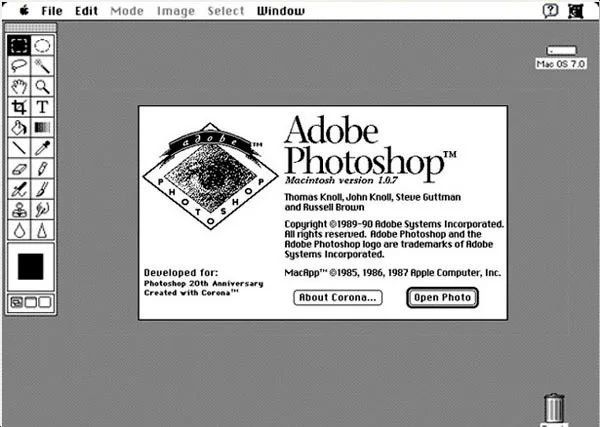
The collaboration took off: Thomas refined the code, integrating digital versions of traditional darkroom techniques (such as brightness, contrast, and Levels), while John tested and pushed the software’s capabilities. Initially called ImagePro, the software was eventually rebranded as Photoshop.
3. The Adobe Acquisition and the 1990 Launch
After pitching the software to several skeptical Silicon Valley investors, the Knoll brothers found the right partner in Adobe Systems. Recognizing the immense synergy with their creative software lineup, Adobe acquired the distribution license.
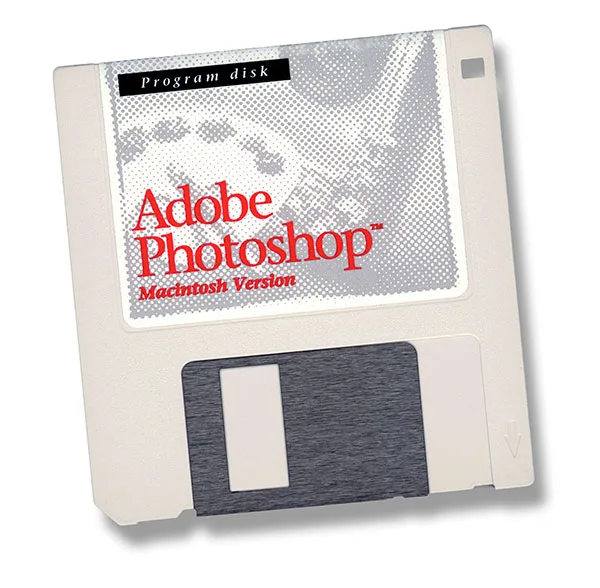
On February 19, 1990, Adobe Photoshop 1.0 officially hit the market exclusively for Macintosh. In an era when digital cameras were nearly nonexistent and high-resolution scanners were prohibitively expensive, Photoshop found its earliest, most passionate champions among prepress professionals and graphic designers.
4. The Digital & Printing Boom
As the 1990s progressed, the rise of the World Wide Web, high-resolution inkjet printing, and digital cameras eliminated the barriers to digital image processing. Designers no longer had to rely on scanning physical film slides; direct digital workflows took over. Photoshop became the engine driving this creative transition.
Professional Image Precision at Printily
At Printily, the principles established during this revolution remain at the core of our daily craft. Mastering modern digital tools goes far beyond applying simple edits—it requires strict control over pixel density, prepress resolution (DPI), color management (CMYK vs. RGB), and vector precision.
Whether you need artwork created from the ground up or complex assets prepared for large-format signs, storefront branding, or promotional merchandise, our team ensures every file is prepared for razor-sharp physical output.
Bring your vision to life with Printily’s precision design and high-definition printing solutions.
Discover more from Printily
Subscribe to get the latest posts sent to your email.
